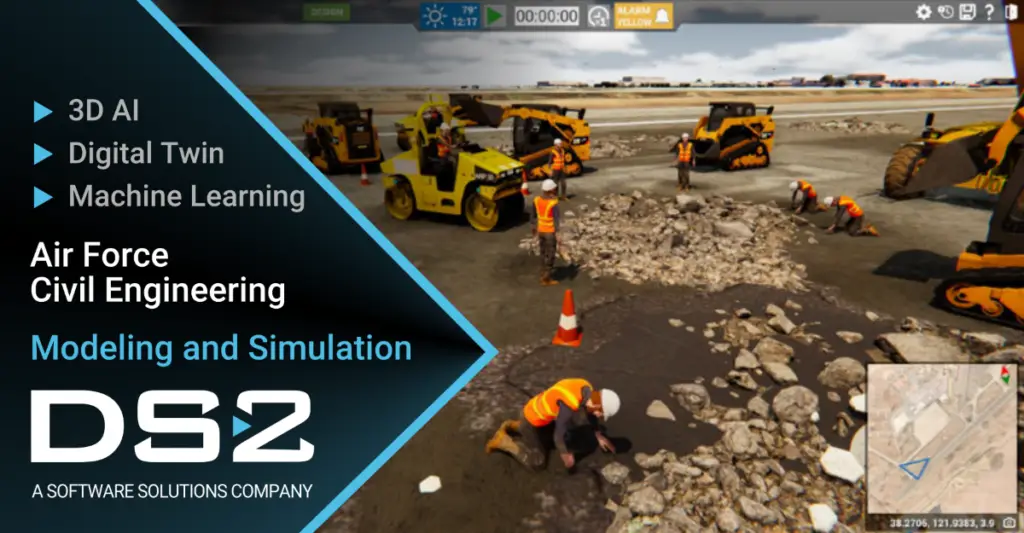
Despite the extraordinary technological advances of the past century, some capabilities remain beyond our reach, such as controlling the weather, traveling through time, or accessing limitless resources. Modeling and Simulation help close these gaps, and DS2’s Airfield Damage Simulator is a prime example of how today’s technology provides visually immersive simulations, real-time insights, and risk-free decisions enabling faster and smarter decisions.
When an airfield is damaged, one of the highest priorities is restoring minimal operational capability as quickly as possible. To prepare airmen for these scenarios, AFCEC provides training exercises that are conducted to replicate the repair process under realistic conditions. Historically, this type of training required large amounts of heavy equipment, skilled operators, ability to damage pavement surfaces, and significant materials to repair and test the techniques and timing due to personnel, weather, equipment, etc. With the Airfield Damage Simulator, airmen can now conduct these exercises entirely within a classroom environment. The simulator can recreate unlimited damage scenarios, equipment availability, weather conditions, and repair progress, all while providing real-time feedback on the duration and effectiveness of each step in the process.
This approach enables rapid iteration and repetition of training while significantly reducing both cost and logistical requirements. By lowering the barrier to entry, even airbases without access to extensive repair equipment can still conduct meaningful and effective training.
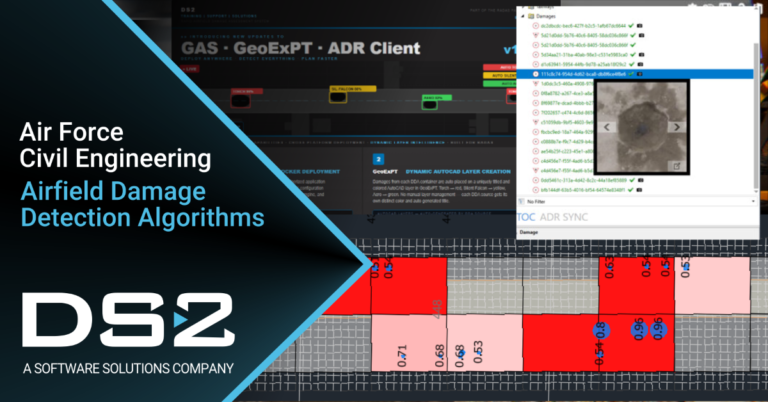
The simulator also introduces a form of “time travel” into the training environment. Airmen can immediately see the outcomes of their decisions without committing real-world resources, allowing them to experiment, refine strategies, and explore the limits of their equipment across a variety of repair scenarios. As simulation models become more connected to real-world systems, the need for efficient real-time data exchange is growing. DS2 has been improving its backend architecture for several years now creating a highly dynamic, real-time connected environment.